01
Capture the source, purpose, timing, and limits of an authorized observation.
Arcus helps organizations determine which trips, visits and other actions qualify under their program rules, retain the evidence behind each decision, and report the results.

One connected model. Distinct steps.
A traceable reason for every decision.
Capture the source, purpose, timing, and limits of an authorized observation.
Evaluate a claim against the program’s named rules and evidence thresholds.
Preserve reasons, uncertainty, and a path to review alongside the decision.
Record the qualifying result and any authorized action with its decision lineage.
Each observation carries where it came from, why it may be used, and when it expires.
source: partner_checkin purpose: arrival-policy observed_at: 2026-10-17T19:42Z consent: program-scoped retention: 30d
Incentives and downstream actions are optional, program-specific effects. Artifact fields are illustrative, not an API contract.
Inspect an executed local evidence-to-receipt example with synthetic inputs
Start with a bounded question.
Define what sufficient evidence means.
Evaluate an arrival claim against a defined place, time window, and evidence threshold. Return a reasoned result before a program authorizes its next step.
Location and check-in corroborate the claim.
POLICY: arrival-policy / v1.2This illustrative receipt records a qualifying event under the example policy. Impact claims also need a baseline and measurement method.
Concept demonstration. These examples explain the proposed model; they do not establish API availability or program readiness.
Explore the infrastructure behind better travel, verified participation, and accountable outcomes.
Connect qualifying mobility choices to the Verified Outcomes Engine, policy-defined decisions, and privacy-preserving program reporting.
Explore TDM 02 / VENUES & MERCHANTSDefine which visits qualify, issue a decision and receipt for each arrival, and understand repeat participation and cost per outcome.
Explore venues & merchants 03 / CONSUMER APPLICATION EXAMPLESFrom coordinating a journey to checking in at a show, consumer applications connect everyday participation to accountable outcomes.
See the applicationsTrust is more than a result.
It’s knowing what the result establishes.

The design starts with authorized evidence, program scope, consent, and minimum necessary disclosure.
An observation, a claim, a policy decision, and a disclosed outcome each have a different meaning.
Policy versions, evidence limits, reason codes, and review paths belong with consequential decisions.
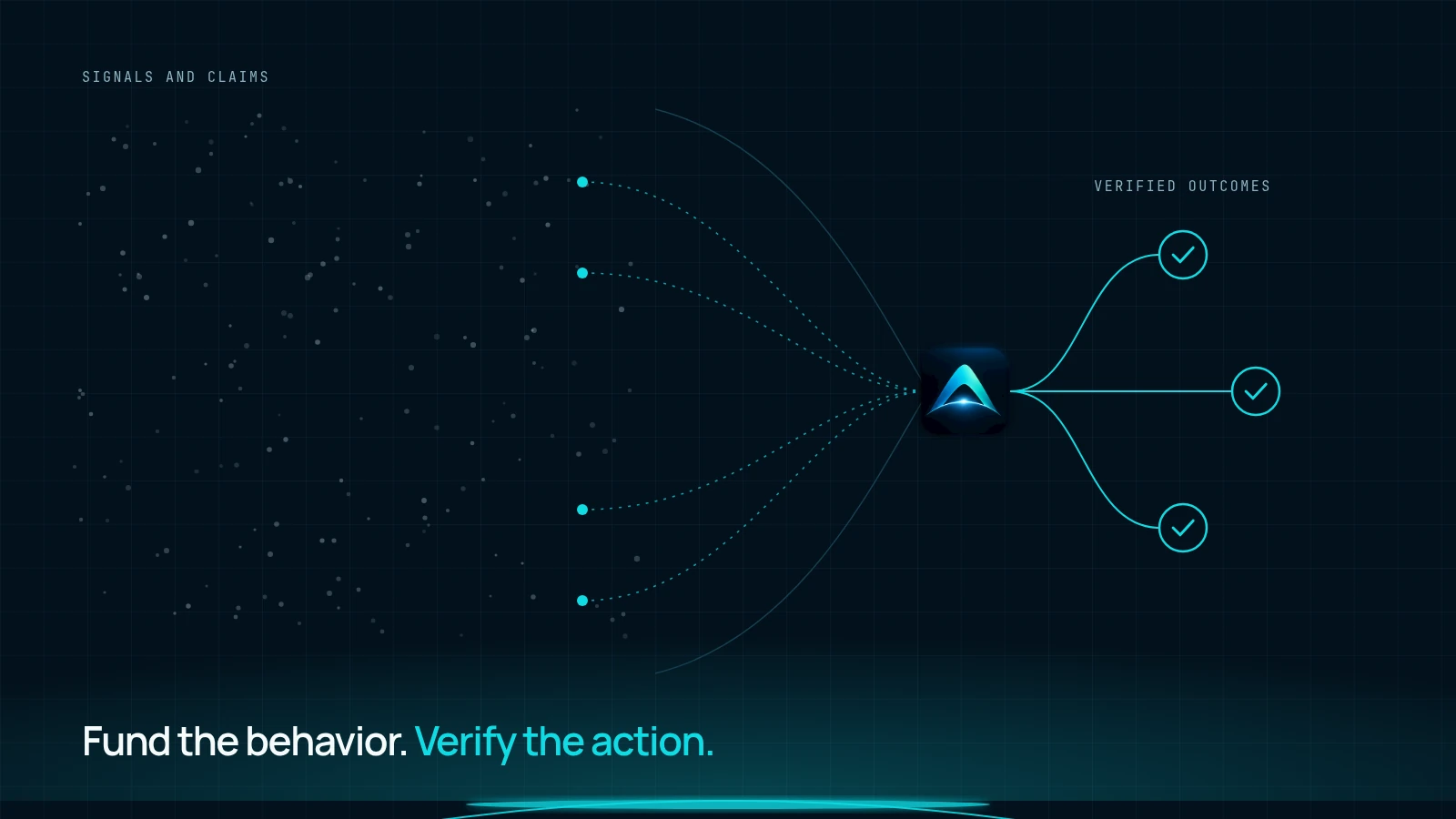
Fund the behavior. Verify the action.
Measure whether your program changes behavior.
Hytch and Tally are MobileFlow platforms with distinct participant experiences. Arcus supplies the common evidence and decision model. Independent licensing is a proposed path for other applications to use that infrastructure while retaining their own experience.
See the consumer applications →
Tell us about your program, the evidence you can access, and the decision you need to support.
How Arcus connects program goals, verified decisions, and privacy-preserving evidence to results you can explain.
Explore the resource library →Arcus is MobileFlow's verified-outcomes digital infrastructure: a foundation for verifying real-world action and turning it into accountable records and privacy-preserving insight. Its model brings authorized evidence, program rules, verification decisions, and outcome records together so organizations can confirm qualifying behavior, understand results, and improve their programs. Arcus verifies; any incentive stays with the program owner, under its own contracts.
No. Arcus is verification only. An organization defines the qualifying behavior and the evidence its policy requires; Arcus evaluates each claim and issues a decision and an outcome receipt. If the organization pays an incentive, it distributes it under its own contracts and uses the receipt as its record. Arcus does not hold, reserve, cap, or pay out money. Availability depends on the agreed program.
Verified outcomes document which actions met program rules. To evaluate whether an intervention changed behavior, including single-occupancy vehicle travel, combine those records with an appropriate baseline, a defensible comparison and a stated measurement method. Report qualifying trips, repeat participation, cost per outcome and uncertainty. Verification alone does not establish causation. Report modeled emissions with their assumptions and uncertainty.
Arcus's design uses purpose-bound consent, minimum necessary disclosure, and reporting that favors aggregate results over individual traces. Program partners should receive the result and evidence context they need, while coarse geography, limited retention, and small-group suppression reduce exposure. Privacy controls must be agreed and validated for each deployment; aggregation alone does not guarantee anonymity in every context.
The same foundation could support transit incentives, employer commute programs, safe-ride initiatives, verified venue participation, and other programs that need a qualifying action verified before an incentive or operational decision. Over time, authorized APIs, portable receipts, and privacy-preserving analytics could help organizations coordinate programs, compare outcomes, and direct funding toward actions that advance their goals.
Start with one behavior you want to encourage or verify, the evidence you can use with permission, and the outcome you want to measure. Contact us to define the program, decision rules, and privacy boundaries together.